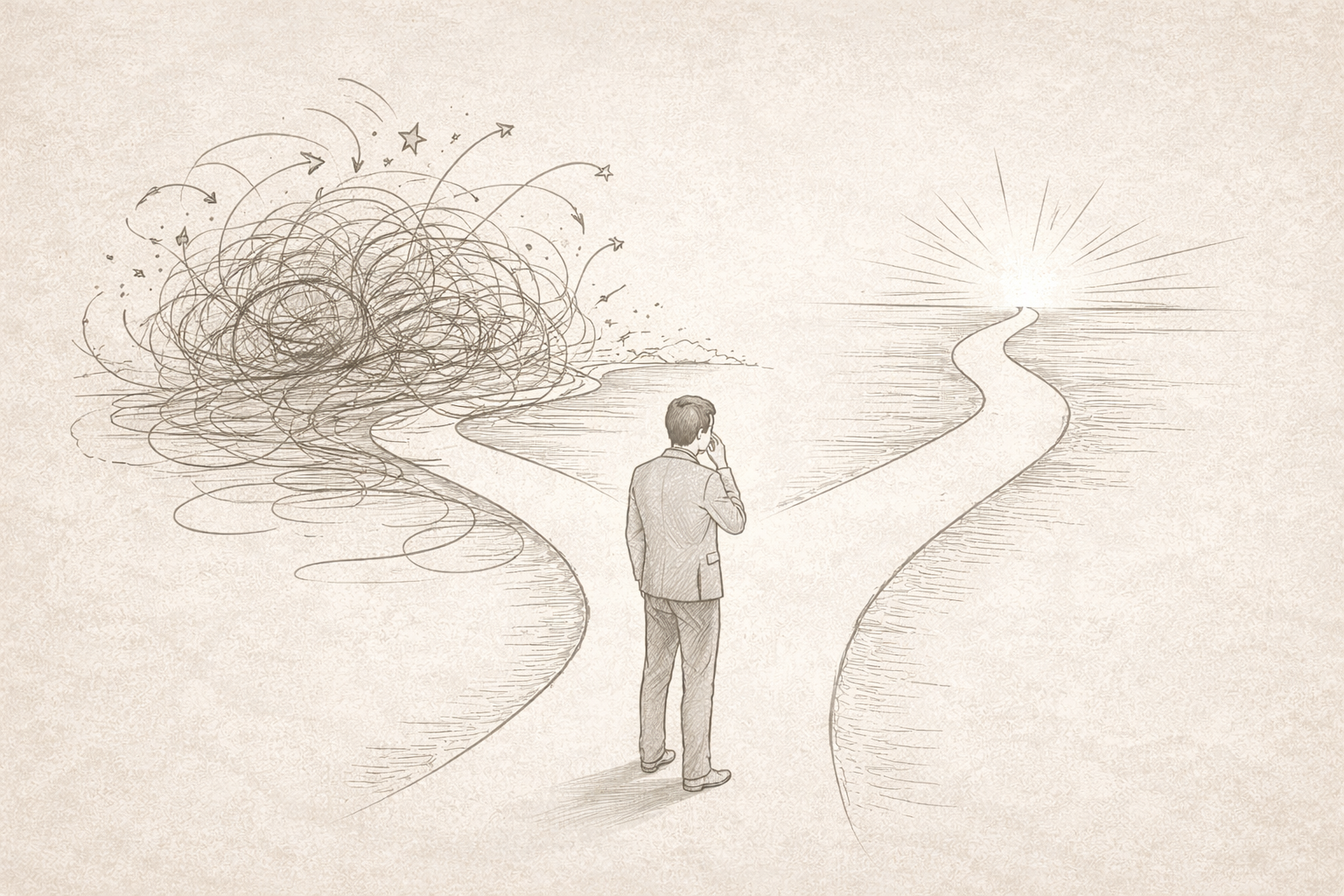

One of the reasons I started Crysto.light was because I wanted to create a space where spirituality and critical thinking could comfortably exist together. The more time I’ve spent studying astrology, tarot and the history behind these traditions, the more I’ve realised that I don’t have to choose between appreciating mystery and asking good questions. In fact, I think the two often strengthen each other.
Over the past year, however, I’ve found myself becoming increasingly uncomfortable with a growing trend within the spiritual community. My discomfort has very little to do with astrology, tarot, Reiki, meditation, ritual or even beliefs that cannot currently be proven by science. I’ve never believed that every meaningful human experience has to be measurable in a laboratory, and I don’t think science has a monopoly on wisdom. At the same time, I don’t think spirituality should be exempt from clarity simply because it deals with ideas that are difficult to measure.
What concerns me is something much simpler. I have noticed that spiritual language is becoming increasingly elaborate while, at the same time, becoming increasingly difficult to understand. It is now common to come across phrases such as “quantum shifting”, “priestess codes”, “frequency activations”, “golden-era transmissions”, “sacred containers” and “New Earth embodiment”. These expressions are often accompanied by concepts borrowed from psychology, astrology, Reiki, Jungian theory, Internal Family Systems, ancestral healing, past-life work and various spiritual traditions, all presented together within the same offering.
To be clear, I don’t think there is anything inherently wrong with studying multiple disciplines. Some of the most insightful practitioners I’ve met draw inspiration from philosophy, psychology, religion, mythology and contemplative traditions. Interdisciplinary learning can be incredibly valuable when it is done thoughtfully.
What I find myself wondering, however, is how these ideas are actually being integrated. What is the underlying framework? Why are these particular traditions being combined? How does the practitioner distinguish between something they regard as symbolic, something they understand through experience, and something they believe to be objectively true?
Those questions matter because language shapes understanding, and understanding shapes consent. If someone is asking another person to invest their time, trust and money into a spiritual service, I think that client deserves to understand what is actually being offered.
One of the simplest questions I now ask whenever I encounter a spiritual offering is this: if someone with no spiritual background asked what happens during a session, could the practitioner explain it in plain English?
If someone told me, “We’ll explore your birth chart to understand recurring themes in your life, and we’ll use tarot as a reflective tool to help you think through the decisions you’re currently facing,” I would immediately understand what they meant. I may or may not agree with every aspect of their practice, but at least I know what I’m consenting to.
On the other hand, if someone tells me that they facilitate multidimensional quantum transmissions to activate dormant priestess codes inside a sacred container, I genuinely have no idea what that means. My concern isn’t that the language sounds mystical. My concern is that I cannot translate it into a concrete understanding of what the practitioner is actually doing.
I also want to make an important distinction here because I don’t think mystery and vagueness are the same thing.
Mystery has always had a place within spirituality. Ritual, symbolism, mythology and contemplative practice attempt to express aspects of the human experience that often resist simple explanation. I don’t think every spiritual experience can or should be reduced to a checklist of measurable outcomes.
Vagueness, however, is something different. Vagueness occurs when language becomes so abstract that it becomes difficult to ask meaningful questions about it. If every unfamiliar term is explained using another unfamiliar term, understanding never actually increases. Instead, the language begins to create the impression of depth without necessarily providing greater clarity.
Ironically, the more I have studied astrology over the past few years, the less absolute my own language has become. The more history I read, the more I appreciate the complexity of different traditions. The more charts I interpret, the more careful I have become about distinguishing between established astrological techniques, symbolic interpretation, personal intuition and my own subjective opinions. Learning has made me more precise, not more certain.
That is one of the reasons I describe astrology as a map rather than an answer, and tarot as a compass rather than a prediction. These tools can encourage reflection, highlight patterns and help us think about our lives from different perspectives, but they do not remove uncertainty, nor do they remove our responsibility to make our own decisions.
I hold myself to the same standard that I hope to see from other practitioners. If someone ever asked me what happens during one of my astrology consultations or tarot sessions, I would want to be able to explain it without hiding behind mystical language. If I cannot describe my work in clear and ordinary terms, then perhaps I don’t understand it as well as I think I do.
Ultimately, this isn’t an argument against spirituality. It is an argument for clarity. I believe spiritual practitioners have an ethical responsibility to communicate in ways that help people understand rather than impress them. Clients deserve to know what ideas are grounded in historical traditions, what conclusions are based on personal experience, what is intended symbolically and where reasonable people may disagree.
Perhaps that standard sounds less magical than speaking about transmissions, activations or quantum shifts. Personally, I think it demonstrates something far more valuable.
It demonstrates respect for the intelligence of the people who have chosen to place their trust in us.
If there is one principle I hope continues to guide my own work, it is this: real wisdom should become clearer the deeper we understand it, not more obscure.