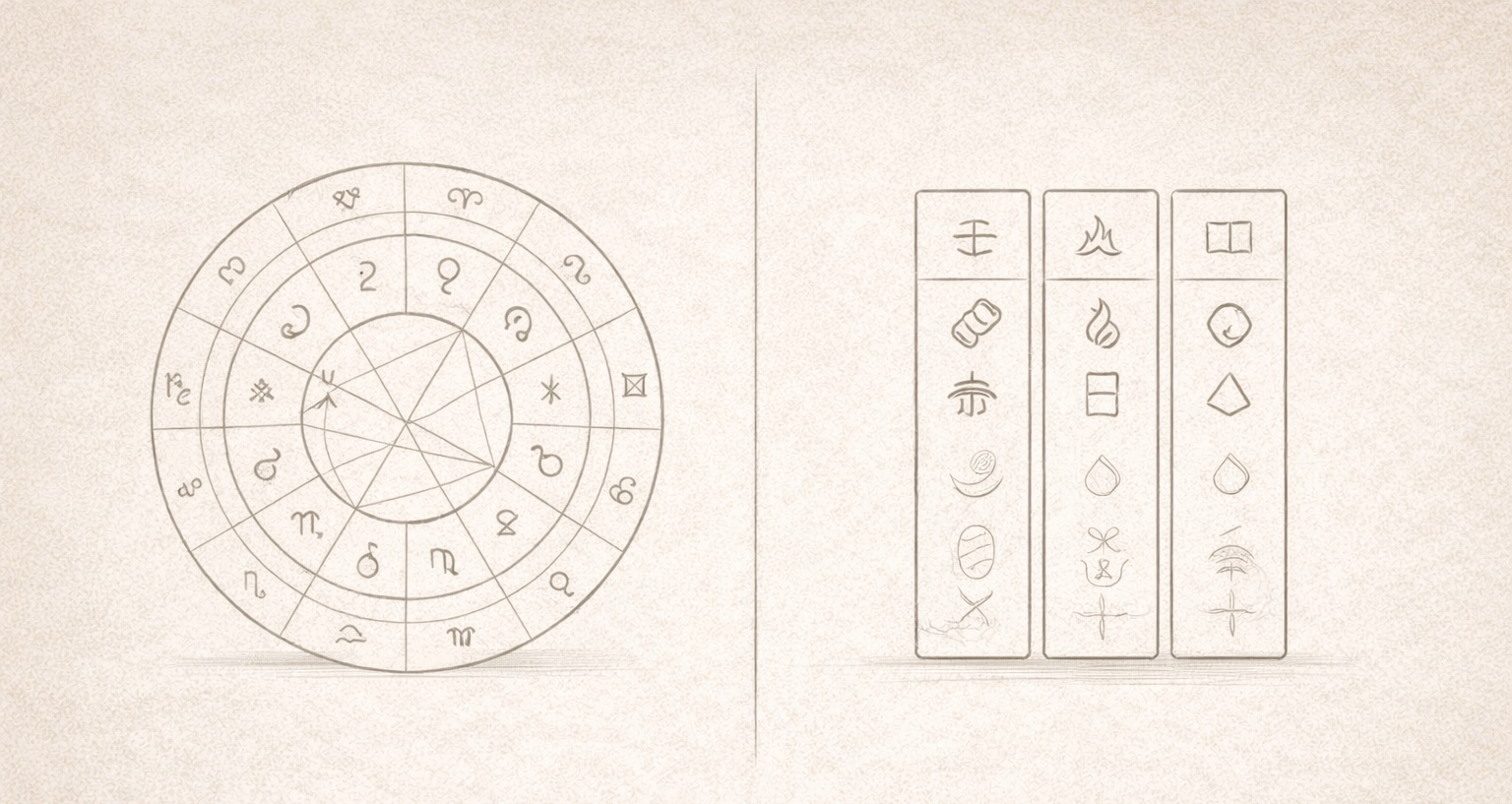

One of the articles that recently resonated with me was written by Master Sean Chan on how to read a BaZi chart. As someone who has been studying BaZi more seriously over the past year, it reminded me just how nuanced this system really is. More importantly, it reinforced something I’ve been thinking about for a while now, which is that the biggest mistake many beginners make isn’t a lack of knowledge. It’s actually the tendency to reduce something incredibly complex into a handful of simple labels.
Like many people who first discover BaZi, I was fascinated by all the different stars. Wealth Stars, Husband Stars, Nobleman Stars and Peach Blossom Stars. Every new concept felt like another piece of the puzzle, and it was tempting to believe that finding one particular star would finally explain why life had unfolded the way it had.
The internet certainly encourages this way of thinking. Today, you can generate a BaZi chart in seconds, and social media is filled with videos telling you to “find your Husband Star”, “check if you’re a strong or weak Day Master”, or “see whether you have Nobleman luck”. Before long, people begin introducing themselves with these labels. They say they don’t have a Husband Star, that they’re a weak Day Master, or that they’re missing the Wealth element. Over time, these observations quietly become identities.
The reality is that a BaZi chart was never meant to be read this way. Every element interacts with another. The season of birth matters. The chart structure matters. The balance of the Five Elements matters. Timing matters. The Luck Pillars matter. Each individual component only makes sense when viewed in relation to the whole chart. Trying to understand someone’s life by looking at a single star is a little like trying to understand an entire novel after reading only one sentence. The sentence may be true, but it is far from the complete story.
Interestingly, I see the exact same misunderstanding happen in Western astrology. Someone discovers they have Saturn in the 7th house and immediately assumes they’ll marry late. Someone else sees Pluto in the 7th house and concludes they’re destined for difficult relationships. Others explain everything through their Sun sign alone. While these interpretations aren’t necessarily wrong, they are incomplete because a natal chart was never designed to be interpreted one placement at a time. Every planet, sign, house, aspect and timing technique contributes to the overall picture. Saturn in the 7th house, for example, could describe delayed commitment, an attraction to mature partners, or even someone who develops exceptional wisdom in relationships. The placement hasn’t changed. The context has.
This is one of the reasons I enjoy studying both Western astrology and BaZi. Although they are different systems, I don’t see them as competing with one another. Instead, I see them as answering different questions about the same person.
Western astrology tends to focus on our inner world. It explores our personality, motivations, emotional patterns, strengths and blind spots. BaZi, while it certainly reflects aspects of personality, places much greater emphasis on timing, life cycles and the relationship between ourselves and our environment. One helps me understand how a person is naturally wired, while the other helps me understand when certain themes are more likely to emerge and what season of life they may be navigating. Together, they provide a much richer perspective than either system could offer on its own.
Perhaps the greatest lesson both disciplines have taught me has very little to do with metaphysics and everything to do with life itself. Life moves in seasons. Just as nature has spring, summer, autumn and winter, every one of us will experience periods of growth, stability, challenge and renewal.
No chart, no matter how favourable, is exempt from difficult seasons.
Likewise, no challenging chart condemns someone to a lifetime of hardship. A well-structured chart isn’t valuable because it never encounters adversity. Rather, it is often more resilient when adversity inevitably arrives, much like a healthy tree whose deep roots allow it to survive winter before flourishing again in spring.
This is also why I think it’s important not to view the Luck Pillars as fixed predictions of what will happen to us. They describe changing environments and changing conditions. As one ten-year phase comes to an end and another begins, our priorities shift, new opportunities appear, and different challenges emerge. We cannot always choose the season we enter, but we do have a say in how we move through it.
Of course, not everything is within our control. None of us chooses the family we are born into, the economy we inherit or every workplace we find ourselves in. Some people genuinely begin life with greater obstacles than others. Acknowledging that reality doesn’t mean we are powerless. While we cannot control every circumstance, we do influence how we respond to those circumstances. Our decisions shape our habits. Our habits shape our character. Over time, our character influences the relationships we build, the trust we earn and the opportunities that naturally come our way.
This is why I’ve become increasingly uncomfortable when people describe someone as simply being “lucky”. Take the Nobleman Star as an example. Does it mean someone is destined to have benefactors appear throughout life? Perhaps. But perhaps people who consistently demonstrate integrity, humility, kindness and generosity naturally cultivate relationships where others want to support them. Character builds trust. Trust creates opportunities. What appears to be luck may, in many cases, simply be the quiet compounding effect of cause and effect. Nature has always worked this way. Healthy ecosystems thrive through balance, cooperation and adaptation, and human relationships are often no different.
The more I study metaphysics, the less I see it as a system for predicting isolated events. Instead, I see it as a language that describes the patterns and rhythms already present in nature.
It reminds us that context matters more than labels, that every season serves a purpose, and that people are far too complex to be defined by a single placement, a single star or a single phase of life.
The more I study BaZi, the less interested I become in finding individual stars. I’m far more interested in understanding the person standing behind the chart. Every chart tells a story, but stories are never understood through one sentence alone. They are understood by appreciating how every chapter connects to the next.
Perhaps that is the greatest gift metaphysics has to offer. Not the promise of certainty or the ability to predict every twist and turn in life, but the wisdom to understand ourselves more deeply, navigate life’s changing seasons with greater awareness, and make better decisions along the way. To me, that is far more valuable than simply knowing what the future might hold.