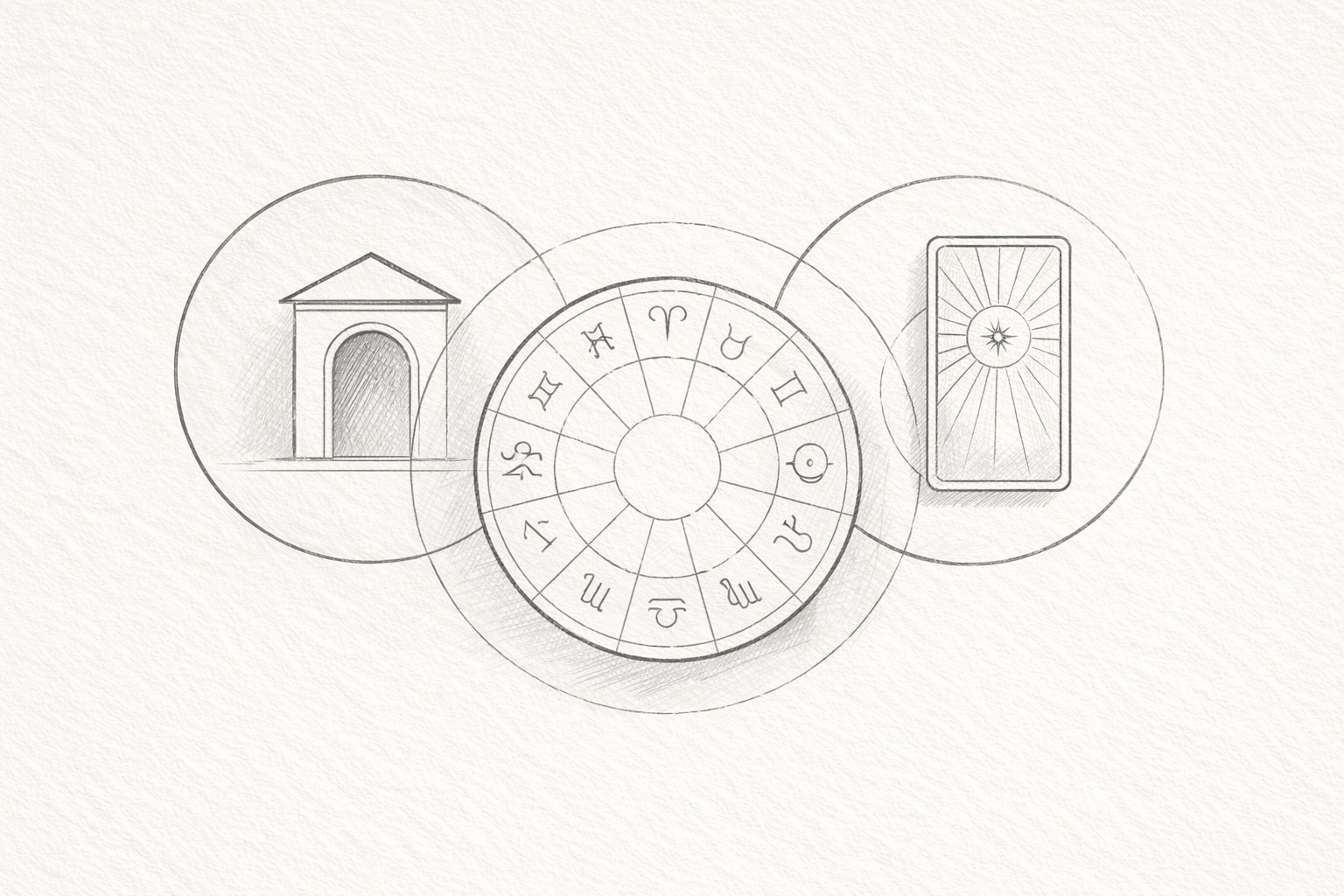

Every now and then, someone asks me whether religion, astrology, and tarot complement each other or whether they are fundamentally incompatible systems that cannot coexist without contradiction.
It is a sincere question, and one I have thought about for a long time, especially because I grew up exposed to religious teachings while also finding deep meaning in symbolic systems like astrology and tarot.
On the surface, these frameworks appear to occupy different worlds. Religion is often structured around doctrine, scripture, divine authority, and community. Astrology and tarot operate through symbolism, archetype, timing, and reflection. One may emphasise faith in a singular truth, while the others emphasise interpretation and pattern recognition.
But beneath those structural differences, I have noticed something shared.
All of them, in their own way, are responses to the same human longing. They attempt to answer the questions that surface quietly in almost everyone at some point: Who am I, really? Why am I here? How do I make sense of suffering? How do I move forward with integrity?
Religion often anchors those questions in devotion and obedience to a higher authority. Astrology and tarot approach them through cycles and mirrors, offering a language that helps us see ourselves more clearly within time and circumstance. The methods differ, but the impulse feels familiar. We are searching for orientation in a life that can feel uncertain and overwhelming.
I do not see one as superior and the other as inferior. They are, to me, different languages attempting to describe meaning.
Of course, not everyone shares that perspective.
Within Christianity, for example, there is often the belief that anything outside of God’s word, including astrology or tarot, risks becoming a false idol. I understand where that boundary comes from. Religion seeks to protect devotion by drawing clear lines around what is considered sacred and what is not.
I do not condemn that position, but I also do not personally align with it. What I have observed over time is that when we insist there is only one legitimate path, we reduce our capacity for nuance. We stop listening. We stop exploring. The conversation shifts from understanding to defence.
And once belief becomes defensive, it often breeds division.
That, to me, feels like a loss, because spirituality at its core is meant to expand compassion rather than narrow it.
For my own life, integration has felt more honest than separation. I still meditate on Guan Yin and find deep grounding in her embodiment of compassion. That practice does not conflict with my use of astrology or tarot; it steadies it. When I sit with a chart or lay out cards, I am not worshipping symbols. I am engaging tools that help me reflect, time decisions more wisely, and examine my own patterns more honestly.
They do not replace devotion. They actually refine awareness.
There are people who find everything they need within one religious tradition, and I respect that. There are others who weave together practices from different systems in a way that feels coherent to them. I fall into the latter category, because I have found that different frameworks illuminate different aspects of the human experience.
Spirituality, at least as I understand it, is deeply personal. It is less about which doorway you enter and more about what happens to your character once you walk through it. Does it make you more compassionate, more honest, more accountable? Does it help you live with greater clarity rather than fear?
If it does, then it is serving its purpose.
Whether someone finds that through religion alone, through astrology and tarot, or through a blend of traditions, the underlying search is similar. We are all trying to locate ourselves within something larger than our individual anxieties. We are all looking for connection, meaning, and a sense that our lives are not random.
The frameworks may differ but the longing is shared.
And perhaps that is enough.