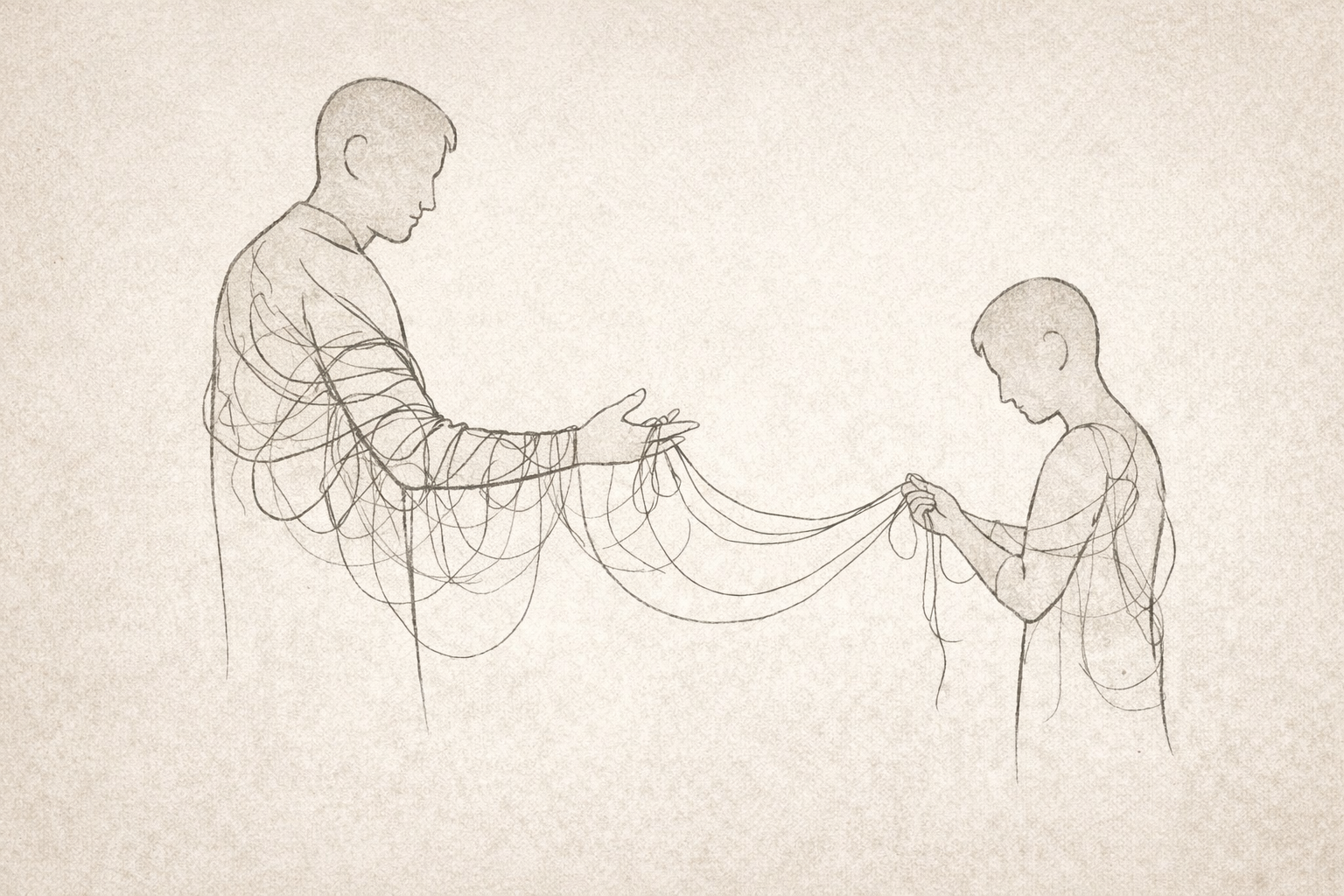

Recently, my dad tried to reconnect with me again.
On paper, that sounds simple. Even hopeful. A father reaching out. A daughter reconsidering. Maybe time has softened things.
But some relationships are not that straightforward. And some fathers are not the kind people easily understand.
There are daughters who grow up with visibly abusive fathers. Alcoholic fathers. Violent fathers. Absent fathers. Those stories are painful, but they are clear. People know how to react to them.
Mine is harder to explain. I grew up comfortable. There were no money worries. We lived in a big house. There were big cars. Provision was never the issue. From the outside, it looked like security. It looked like success.
But security and safety are not the same thing.
Growing Up Under Power
My father is a powerful man. Not just financially. Psychologically. In business, he thrives. He can influence, persuade, reposition, negotiate. He has an innate ability to read people and move conversations in his favour. People admire that about him. They call it charisma. Leadership. Sharpness.
But when you grow up under that kind of power, something else happens quietly.
When you’re a child and your survival depends on one dominant figure, you learn quickly what is safe and what is not. Retaliating doesn’t feel like courage. It feels like the end of the world. So you adapt. You stay quiet. You read the room. You swallow certain truths because the cost of saying them feels too high.
No one has to explicitly say, “Your feelings don’t matter.” You just slowly understand which feelings get space, and which ones don’t.
The Kind of Manipulation That Leaves No Bruises
The hardest part is that there are no bruises to point at. No dramatic incidents that make people gasp. It’s subtler than that. It’s the way your “no” turns into a discussion. The way your boundaries become something to analyse and debate. The way a disagreement gets reframed until you’re no longer sure what you were even standing up for.
I eventually grew up feeling like I had no real voice.
Because every time I said no, it wasn’t accepted as an answer. It was treated as resistance. As rebellion. As something to correct.
He would use me like a chess piece, especially in situations involving my mother, my sisters, or even his business partner. I was often positioned in the middle. Persuaded to say things that made me uncomfortable. Nudged to carry messages that weren’t mine. Sometimes even pressured into telling half-truths, just to “keep the peace” or to help secure an outcome he was aiming for.
It was always framed as strategic. As necessary. As the smarter way to handle things. He would explain why it made sense. Why this was the practical move. Why emotions had to be managed. Why timing mattered. Why certain truths didn’t need to be fully told.
And because it sounded logical, it became very hard to argue against.
And when you’re repeatedly placed in that position, as a child, a teen and someone in their 20s (negotiating between adults, smoothing tensions that were never yours to carry) you slowly lose the instinct to trust your own voice.
You start thinking that discomfort is immaturity. That resistance is rebellion. That compliance equals harmony.
That’s how subtle control work; through persuasion that slowly detaches you from yourself.
He also has a way of flipping narratives. Of painting someone else as unreasonable. Of positioning himself as logical and composed while you start questioning your own reactions.
And if you’ve never experienced him in negotiation mode, you may never understand how subtly controlling he can be. It’s intellectual control whereby your “no” becomes a discussion. Your boundary becomes a problem to solve and your independence becomes something to correct.
And over time, you start questioning your own instincts. You start to explain yourself more than necessary. You start to find yourself constantly having to negotiate your own limits.
That’s the part people don’t see.
And when you grow up inside that dynamic, you don’t even realise how much of yourself you’ve been negotiating away.
Walking Away From Comfort
Walking away from a cushy life (from financial security, from a big house, from the external markers of comfort) is not a small decision. Especially when you’ve been raised to believe that provision equals love.
But at some point, I realised I would rather build a smaller life that belongs to me than live a larger one that requires me to shrink.
So I left the structure.
I chose to earn my own money, downgrade my lifestyle.. Make my own decisions. Live in a way that felt sustainable for my mental and emotional health.
In the process of that, I discovered something more valuable than security: I discovered ownership of my decisions, my income, my lifestyle and my mental health.
For the first time in my life, my survival wasn’t dependent on someone else’s approval.
Why Reconnection Is Not Simple
So when he reached out recently, I wish I could say I only felt clarity. But that wouldn’t be honest.
Seeing him again (seeing how much he has aged) did something to me. Time has softened his face. His body moves a little slower. And he kept repeating that he has limited years left, that we should spend more time together while we still can. That kind of sentence lands heavy.
It doesn’t just touch love. It touches fear. It touches guilt. It presses on the part of you that still wants to be a good daughter.
For a moment, I felt small again because mortality changes the emotional temperature of everything. When a parent reminds you they won’t be here forever, it forces you to confront something primal. You don’t want regret. You don’t want to be the daughter who “wasted time.”
But beneath the sadness, there was something else; Fear.
Because I know my father and I know that whatever he says rarely exists without a layer underneath it.
After spending a bit of time with him, listening carefully, watching the direction of the conversation, the pattern became familiar.
This wasn’t just about spending time together.
He wanted me to abandon the business I’ve built for myself and enter into a new business partnership with him. He needed someone to study and obtain the necessary licenses for a new idea he has. He couldn’t find reliable, capable people to hire. He didn’t know who to trust.
So he reached back to me.
And the hardest part wasn’t even the request. It was the framing. He positioned it as generosity. As legacy. As him wanting to “pass down” what he built so that I could have a comfortable life again.
A cushy life. As if my current life is lacking. As if what I’ve built isn’t already something I chose deliberately.
That’s when the clarity returned.. because underneath the language of love and time and legacy… was need.
He needed help. He needed someone competent and someone he could trust.
And instead of saying that plainly, it became a story about inheritance and security.. about him wanting to “take care” of me. And i simply hate that.
But I am no longer someone who needs to be taken care of and I refuse to confuse being needed with being loved.
I don’t doubt that he loves me in the only way he knows how. But love that arrives with expectations attached, with roles already assigned, with a future already decided… is not a place I can return to without losing myself again.
And I worked too hard to find myself this time.
If There Is A Way Back
I still believe reconciliation is possible but it cannot be built on the old structure of persuasion, conditional acceptance.
It has to be built on mutual respect. One where my boundaries are not arguments, my personality is not something to correct, where my “no” does not trigger a strategy meeting, one where I am not positioned as the solution to someone else’s unfinished plans.
Because this is one aspect of my lived truth about having parents who don’t always act in your best interest; even when they believe they are.
Sometimes, you are not just their child. You are the extension. The contingency plan. The reliable piece on the board. A chess piece placed carefully into a future that was never yours. And the hardest part isn’t the control itself. It’s having the courage to see it clearly. To stop romanticising the version of parenthood you wish you had. To stop clinging to the idea of a perfect parent-child relationship simply because it exists for others.
Yes, some parents did a beautiful job raising their children. Some love was steady and uncomplicated. But not all of us were given that.
Until something fundamentally shifts, distance is not rebellion. It is self-preservation.
And for the first time in my life, I no longer feel afraid to choose it.
If this resonated, you might also read:
– [Growing Up With an Emotionally Unstable Mother]