
One thing I’ve noticed over the years is that people are very good at evaluating what already exists. However, they’re far less comfortable evaluating potential.
Whether it’s a piece of art, a business idea, a home renovation or even a wedding, most people can only respond to what they see in front of them. They can’t fully picture the version that only exists inside someone else’s mind.
I’ve learnt this lesson many times through Crysto.light.
Whenever I collaborate with artists or work on new handmade collections, I often struggle to explain the final vision. Sometimes my team doesn’t quite understand it. Sometimes my customers don’t either. They’ll politely nod along while I’m explaining, but I know they’re only seeing fragments.
Then the finished piece is unveiled, and suddenly everyone says, “Oh… now I get it.”
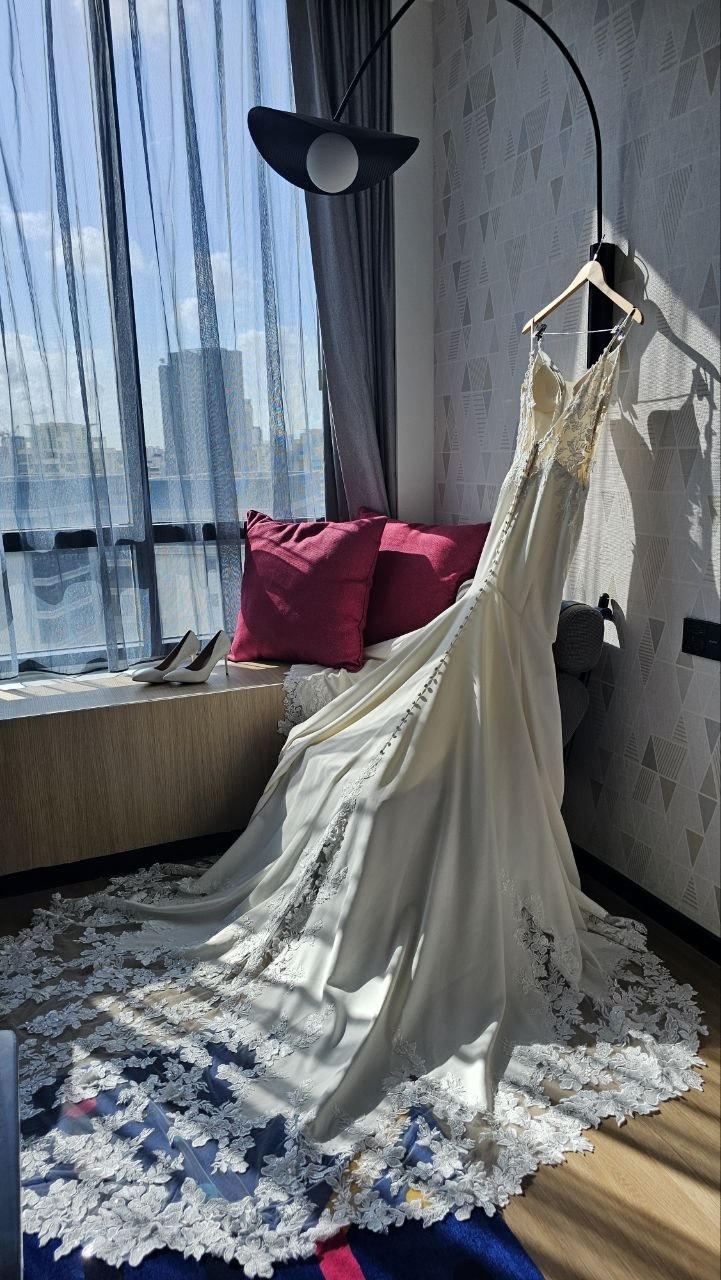
I’ve almost come to expect that reaction. Apparently, my wedding was no different.
Most people don’t know this, but our banquet wasn’t held in Aloft’s main ballroom. We chose the Zhongshan Ballroom instead, a space that was originally designed as a function room rather than a dedicated wedding ballroom. From what I was told, very few couples had chosen to hold their banquet there before, and even fewer had invested in transforming the space with additional lighting, audiovisual equipment, florals and styling.
When I first viewed the room, I completely understood why. The ballroom was perfectly functional, but it didn’t immediately feel like a wedding venue. The lighting was fairly flat (only downcast waram lighting with no spotlights), the atmosphere felt simple, and nothing about it immediately created the sense of warmth and intimacy I had in mind.
What made the planning process particularly challenging was that there was no precedent to work from.
As we started engaging external vendors, I found myself asking the hotel if they had more photographs of the ballroom from different angles, especially backstage areas and technical setups, so that my lighting and production team could better visualise the space. The sales manager genuinely wanted to help, but there simply wasn’t much they could provide.
Nobody had ever done it before.
I remember feeling rather stuck at times because I was trying to explain something that only existed in my imagination, yet I had very little visual material to help everyone else see what I was seeing. Looking back, I’m quite certain there were moments during the planning process where I came across as a rather demanding bride.
From the outside, it probably looked like I simply wasn’t satisfied with what was already there. But the truth was quite different. I wasn’t designing around the room as it existed, I was designing around the room I believed it could become.
My husband, being the practical person that he is, couldn’t quite understand why I wanted to spend additional money on lighting, spotlights, a white carpet, florals and upgraded audiovisual equipment.
Throughout the planning process, we had countless conversations that sounded something like this.
“Why need to spend money on all these things?”
“The room not good enough meh?”
😂
Honestly… He wasn’t wrong. The room was good enough. What I was trying to create, however, wasn’t simply a beautiful room.
It was an experience.
I wasn’t trying to impress people with extravagant styling. I simply knew how I wanted our guests to feel the moment they stepped into the ballroom. Warm. Intimate. Welcomed. Like they were walking into a celebration rather than just another hotel function. Every decision I made was simply in service of that feeling.
After the wedding, something rather unexpected happened.
The banquet manager, sales manager and even several members of the banquet staff came over to tell us they had never seen the Zhongshan Ballroom look like that before.
The sales manager even shared that they were considering speaking to management about improving the ballroom’s permanent lighting and spotlight setup because, for the first time, they could see what the space was capable of becoming.
Apparently, our wedding is now part of their portfolio when showcasing intimate weddings in that ballroom.
I have to admit… that made me smile. Not because I felt we had created the “best” wedding, but because it reminded me of something I’ve experienced repeatedly throughout my life.
Looking back, I realised this wasn’t really a lesson about wedding venues at all. It was the same lesson I learnt when I started Crysto.light, the same lesson I continue to encounter whenever I collaborate with artists in Lijiang, and even the same lesson I experienced while renovating our home. I’ve come to realise that this is one of the recurring themes in my life. Time and time again, I find myself trying to explain something that doesn’t yet exist, whether it’s a creative collection, a living space or, in this case, a wedding. That’s a surprisingly difficult thing to do because people can only evaluate what they can currently see, while you’re making decisions based on a vision that still exists only in your own mind.
When there is no precedent, people naturally default to evaluating what already exists.. Which isn’t a flaw, it’s simply how our minds work. We compare against what is familiar because that’s all we have available.
I’ve also realised this is where many good ideas quietly disappear. It’s not because they weren’t worthwhile, but because their creators abandoned them too early after hearing enough people question them.
Of course, this isn’t an argument for ignoring feedback. Some feedback has made my work significantly better, and I’m grateful for the people who have challenged my blind spots over the years.
In hindsight, perhaps that’s one of the biggest lessons my wedding gave me. It’s okay to hold onto a vision even when you’re the only person who can fully see it, because more often than not, people only understand what you were trying to create after you’ve finished creating it.
If you’re in a season where you’re building something that nobody quite understands yet, whether it’s a business, a creative project, a career change, a relationship or simply the kind of life you want to live, I hope this encourages you not to lose heart too quickly.
Listen to feedback. Stay curious. Be willing to adapt when something genuinely makes the work better. But never mistake a lack of understanding for a lack of potential.
Sometimes the people around you aren’t seeing the same thing simply because they haven’t had the opportunity to see the finished picture yet.
If you’ve done your homework, thought carefully about your decisions and remain deeply convinced by the direction you’re taking, have the courage to keep building.
One day, your work will speak for itself. And perhaps, just like my little ballroom, someone else will look at what you’ve created and quietly say,
“I never knew it could become this.”